Enterprise AI Risk Management Services
Technical success does not settle the production decision
Production readiness depends on more than model performance. Leaders need clear ownership, applicable requirements, independent validation, approval evidence, and a defined response when conditions change. When those decisions arrive late, initiatives can stall or lose control after deployment.
Luminar builds risk management and regulatory readiness into the AI lifecycle from day one, creating a clearer basis for approval, oversight, and action.
Talk to Our Experts

Luminar's Proven Impact at Scale

80%

Why it matters:

Lowers business liability while reducing production model failures and drift issues for tech teams.

95%+

Alignment in regulatory compliance across engagements.

Why it matters:

Satisfies legal/audit standards (ISO 42001, NIST) without requiring engineers to manually build custom tracking systems.

Faster

Deployment via built-in governance, replacing bottlenecked review cycles.

Why it matters:

Business leaders launch products sooner; developers bypass traditional, slow quarterly review bottlenecks.

Stronger

Trust and vastly improved audit outcomes with stakeholders and regulators.

Why it matters:

Gives the board peace of mind and provides developers with automated, immutable audit trails.

Why Traditional Risk Management Breaks in the Age of AI
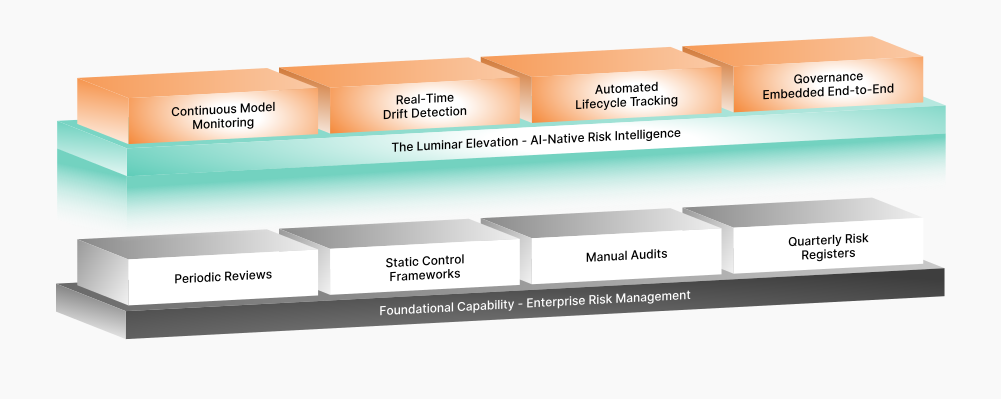
Most organizations invest heavily in AI and data platforms but fail to build the necessary systems to govern them.

Continuous Evolution

Designs the inventories, evidence, workflows, and monitoring oversight depends on.

Inconsistent Frameworks

Risk governance is siloed across different teams and models.

Siloed Monitoring

Data quality and model health tracking lack centralized visibility.

Limited Auditability

A lack of comprehensive lifecycle tracking makes audits difficult.

Regulatory Pressure

Global regulatory expectations are rapidly increasing in complexity.

The result:

Hidden risks accumulate until they surface as costly audit findings, compliance failures, or business losses.
Risk Management, Elevated for AI
Every enterprise manages risk, but few are built to manage the unique challenges AI introduces: models that drift, decisions that compound, and systems that evolve faster than quarterly reviews can track. We take the governance disciplines you already trust and elevate them for systems that learn.
The Luminar TrueLens™ Framework
We bring a structured, enterprise-grade approach to risk management through four interconnected pillars across the AI lifecycle. TrueLens™ isn't a set of principles sitting in a slide deck; it's a framework. Everything below is what actually runs when we say governance is embedded, not bolted on.

People

Ownership, accountability, and executive alignment.

Policy

Governance aligned tightly with global regulatory standards.

Process

Comprehensive lifecycle management from build to validate, deploy, and monitor.

Platform

Real-time monitoring, reporting, and operational control systems.
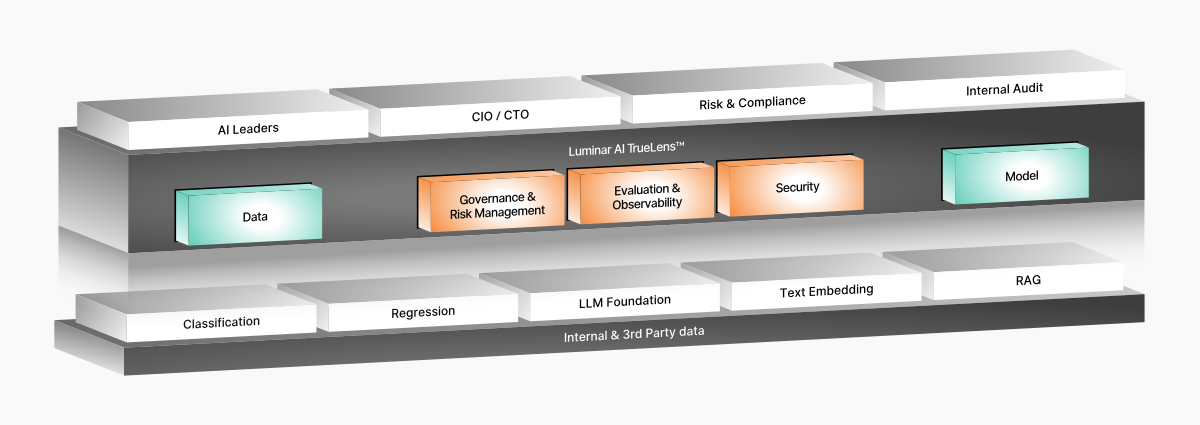
Luminar Automates the Complete Responsible AI Lifecycle Powered by TrueLens™
TrueLens™ isn't a set of principles sitting in a slide deck; it's a framework. Everything below is what actually runs when we say governance is embedded, not bolted on.
Luminar AI Capability Review
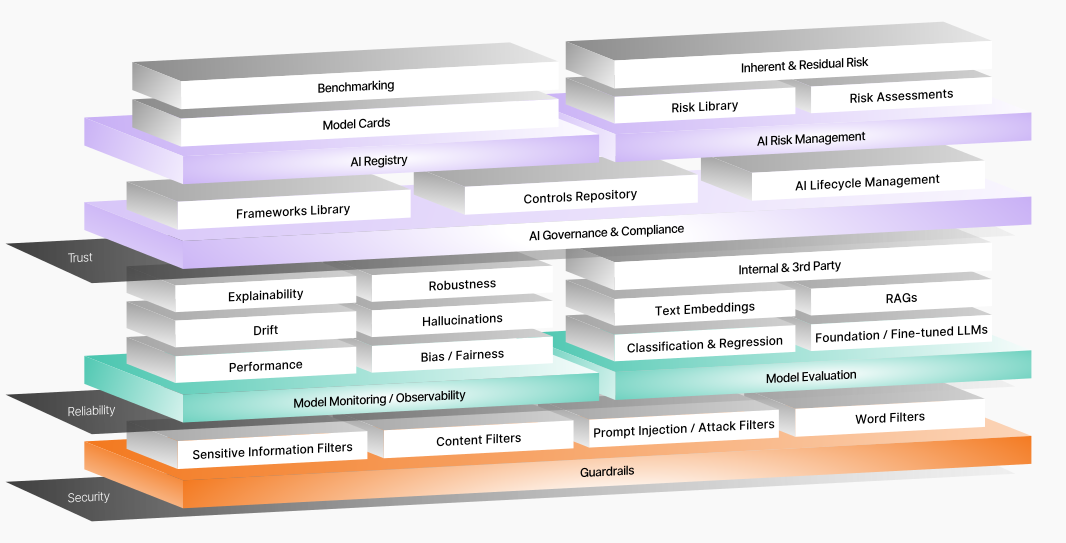
TrueLens organizes AI capability in to tiers using the Trustworthy AI principles.
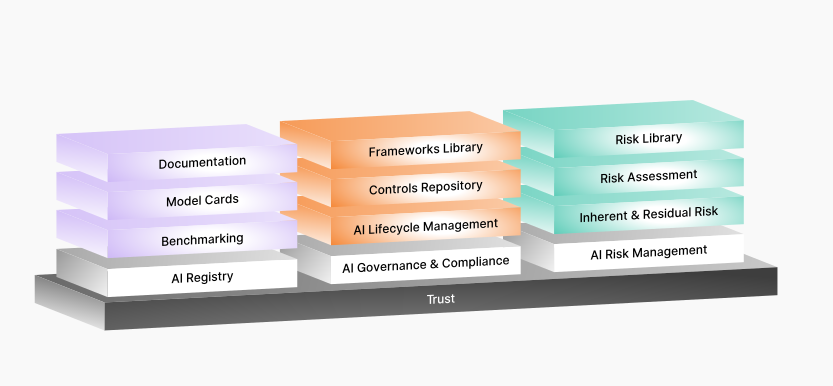
Integrate Governance, Risk & AI Registry
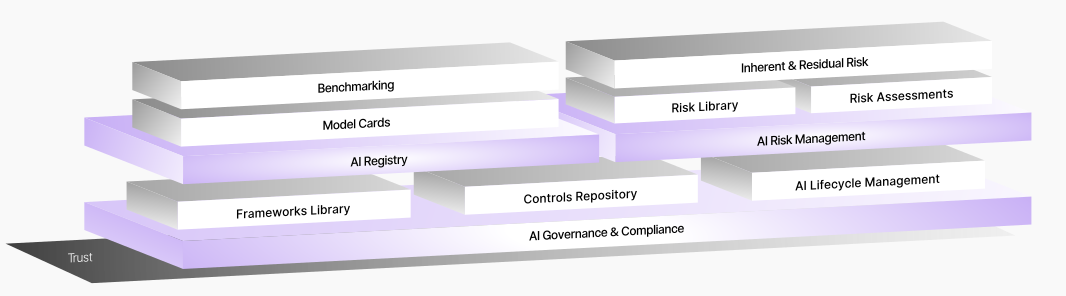
At the center of Trust sits the AI Registry, the single inventory every other capability depends on. You can't govern a model you don't know exists, and you can't score risk for a model nobody's documented.
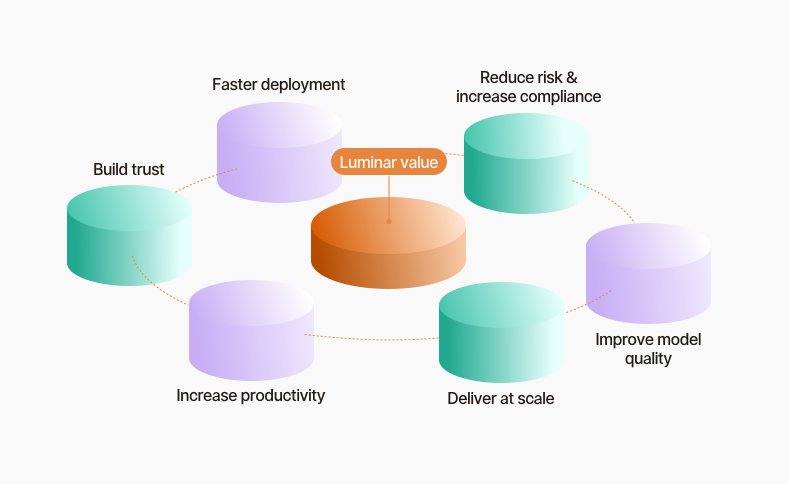
Value Creation, by Capability
Every capability on this page rolls up into one number your board can track: is our AI trustworthy, and can we prove it.
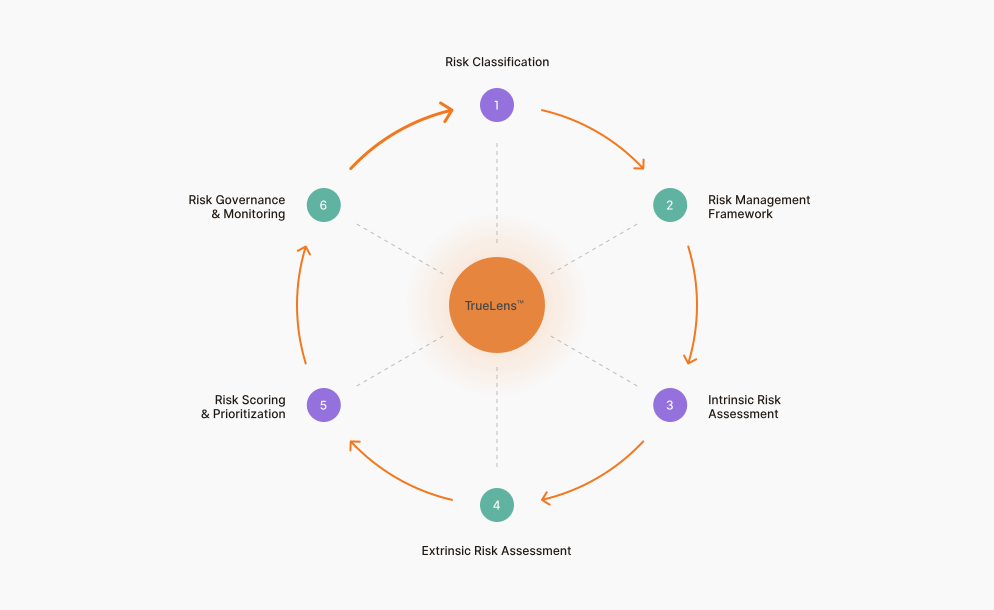
The Six-Step Risk Management Approach
Each step feeds the next, and the cycle runs continuously: governance and monitoring findings in step six feed directly back into how models are classified in step one.
Where We Help
LAYER 01
Trust
Governance, risk, and value that leadership can stand behind.
Trust is what lets AI scale. It comes from knowing which models you run, what risks they carry, which rules apply, and whether they're delivering real value.

AI governance & compliance

Operationalize responsible AI and stay ahead of regulation.

• AI policy frameworks, operating models, and control design

• Frameworks library and controls repository mapped to ISO 42001, NIST AI RMF, and interagency model risk guidance

• Explainability and transparency frameworks

• Audit preparation, remediation, and risk documentation

IN ACTION: We worked closely with regulators and internal audit teams to downgrade and close critical findings, achieving strong compliance ratings.

Model Risk Management

Ensure every model is validated, monitored, and compliant.

• Independent model validation frameworks

• Governance for complex and ensemble models

• Model lifecycle controls

• Regulatory alignment (e.g., Interagency model risk guidance)

IN ACTION: We helped an enterprise resolve major audit findings by standardizing model validation and monitoring, leading to clean audits going forward.

Enterprise Risk Management

Unify risk across AI, data, and business operations.

• Risk taxonomy and classification

• Inherent and residual risk assessments

• Cross-functional governance models

• Risk aggregation and alignment with enterprise frameworks

IN ACTION: We helped an organization align risk, audit, IT, and business teams to create a centralized risk management framework, improving decision-making and audit outcomes.

AI Lifecycle Tracking

Manage AI as a living system.

• AI registry with model cards and benchmarks for every model

• End-to-end lifecycle tracking: build, deploy, monitor, and update

• Version control, lineage, and rollback strategies

• Secure audit trails and automated documentation

IN ACTION: We implemented lifecycle tracking systems that transformed AI operations from ad hoc processes into structured, auditable workflows.

AI ROI Analysis

Connect AI investments directly to business outcomes.

• Tailored ROI measurement frameworks

• Rigorous cost-benefit analysis of models

• Performance vs. business impact tracking

• Portfolio-level AI value reporting

IN ACTION: We enabled leadership to demonstrate clear ROI on AI initiatives, securing multi-year funding and driving 30% year-over-year portfolio growth.
LAYER 02
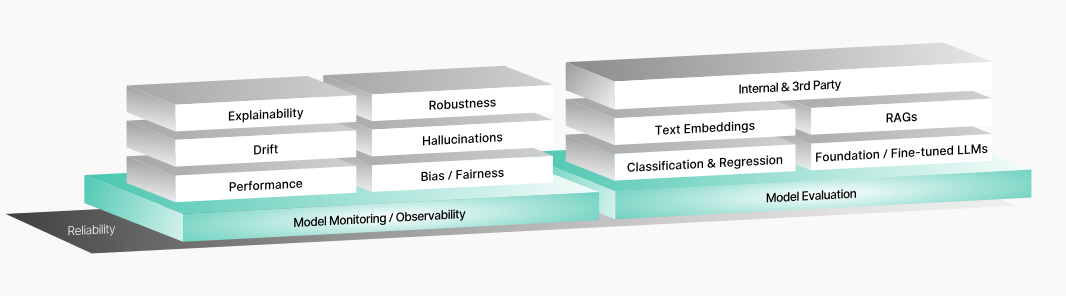
Reliability
Models that perform as expected, on data that holds up.
Once the perimeter is secure, the question is whether the model keeps doing its job. Reliability covers how models are tested before launch, observed in production, and fed by data you can trust.

Model Evaluation & Testing

Continuous evaluation before launch and throughout the model lifecycle.

• Pre-deployment benchmarking across performance, fairness, robustness, and hallucination risk

• Internal and third-party evaluation of models

• Coverage across foundation and fine-tuned LLMs, embeddings, RAG, and classification and regression models

• Instant alerts routed directly to accountable owners

IN ACTION: We introduced diagnostic reporting frameworks for complex AI models, improving transparency and stakeholder trust in model outputs.

Model monitoring & observability

See how every model behaves in production.

• Tracking for drift, performance, robustness, and hallucinations

• Bias and fairness monitoring

• Explainability that shows why a model made a decision

• Control effectiveness testing as models and data change

IN ACTION: We built a centralized monitoring platform that reduced model monitoring cycles from weeks or months to days, enabling real-time governance.

Data Governance

Build trust in the foundation of AI.

• Data quality monitoring and validation

• Data lineage and traceability

• Ownership and stewardship models

• Privacy and compliance controls

IN ACTION: We standardized data quality controls across models, reducing inconsistencies, cutting compliance costs by roughly 30%, and improving audit readiness.
LAYER 03
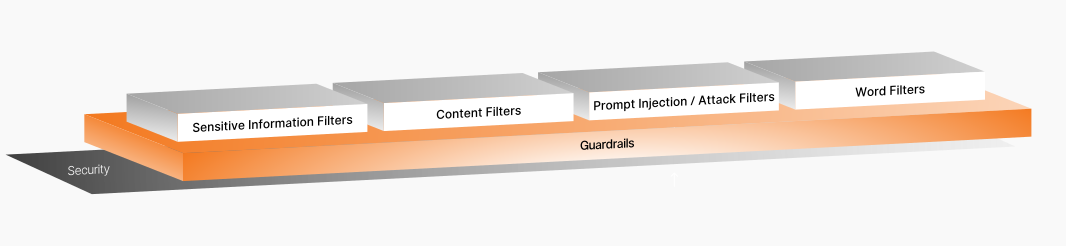
Security
Guardrails that protect every interaction.
Security is the foundation. Before a model can be reliable or trusted, it has to be safe to put in front of users and data.

Input protection

Stop harmful or manipulative prompts before they reach the model.

• Prompt injection and attack filters that detect jailbreaks and manipulation attempts

• Sensitive information filters that keep PII and confidential data out of prompts

• Word and topic filters tuned to your policies

• Logging and alerting on blocked attempts

Output protection

Make sure what the model says is safe to share.

• Content filters for toxic, unsafe, or off-policy responses

• Sensitive information filters that prevent data leakage in outputs

• Word filters aligned to your brand and compliance rules

• Consistent guardrails across every model and channel
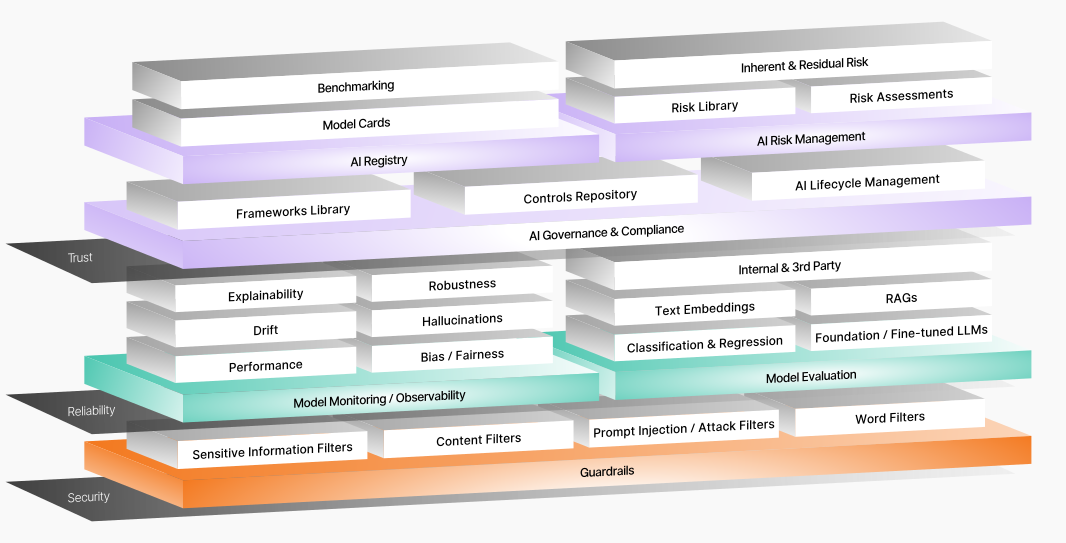
Three Layers, One Assurance Stack
Together  trust, reliability, and security give a complete picture of trustworthy AI, organized the way risk, compliance, and engineering teams already talk about it. Each layer depends on the one beneath it.
Luminar Sightline™
AI doesn't stay accurate, safe, or compliant on its own. Models drift, data shifts, regulations change, and new attack patterns appear long after launch. Model Watch is Luminar's managed assurance service. It keeps every layer of your AI under continuous watch: the guardrails that protect it, the models and data that power it, and the governance that makes it trustworthy. Everything comes back to you as one set of dashboards, metrics, and status reports your risk, compliance, and engineering teams can act on.

Here's what Model Watch covers, layer by layer.

Six Steps Across the AI Lifecycle

Every package is built on the Luminar TrueLens base: the Four-Pillar TrueLens Framework, the Six-Step Risk Approach, and Org-to-Regulation Mapping. Same framework, same rigor. Each step below brings more of the lifecycle under governance.

• Register & Classify: AI registry, model cards, and risk tiering for every system

• Assess & Score: intrinsic and extrinsic risk assessments, with a risk score for each system

• Validate & Approve: independent validation, stage gates, and an approvals log

• Deploy & Change Control: version control, lineage, rollback plans, and a change log

• Monitor & Respond: drift and bias tracking, guardrails, control testing, and an incident log

• Govern & Prove: risk aggregation, an AI council, an audit trail, and a Trust score with ROI

THE AI LIFECYCLE WE TRACK, END TO END

Luminar Sightline™ for AI Risk

Choose How Much of the Lifecycle to Own

System counts are a guide. Which systems are in scope is based on risk tier, so a few high-risk systems can need a higher package than many low-risk ones. Most organizations start at Basic or Intermediate and upgrade as their AI use grows.

01

Basic

Know your AI. Register every system, shadow AI included, with risk tiering, model cards, risk scoring, and a quarterly report. For 1 to 3 systems.

Consulting

Co-Managed

Fully Managed

02

Intermediate

Govern your AI. Everything in Basic, plus independent validation, stage gates, change control with rollback, and monitoring with guardrails. For 10 to 15 systems.

Consulting

Co-Managed

Fully Managed

03

Advanced

Prove your AI. Everything in Intermediate, plus enterprise risk rollup, red-teaming, vendor AI risk, an AI council, and a board-level Trust score. For more than 15 systems.

Consulting

Co-Managed

Fully Managed

TALK TO AN EXPERT ABOUT SIGHTLINE FOR AI RISK

Platform-Powered Risk & Assurance

While we provide elite advisory work, true AI assurance requires a platform, not just a slide deck. We implement and operate your program using industry-leading software, wrapping it in our custom organizational mapping layer.

Lumenova AI

BEST FIT FOR

When the AI models themselves are the primary risk.

CAPABILITIES COVERED

Evaluates LLMs, RAG, and embeddings across 200+ metrics (fairness, drift, hallucination); maps to EU AI Act, ISO 42001, NIST RMF.

Contact us
Vanta

BEST FIT FOR

Organization-wide security, compliance, and vendor risk.

CAPABILITIES COVERED

Automates evidence collection across 35+ frameworks (SOC 2, ISO 27001, GDPR) and handles comprehensive vendor risk.

Contact us
Frequently Asked Questions
Most model risk policies were written for statistical models that change a few times a year. AI models drift, retrain, and change inputs continuously, and generative AI adds new risks such as prompt injection and hallucination. The revised interagency model risk guidance for banks, issued in April 2026, also leaves generative and agentic AI out of its scope, so those systems fall to your broader governance. We keep the controls you already trust and extend them with an AI registry, lifecycle tracking, and continuous monitoring, so oversight keeps pace with systems that learn.

You start with the registry. We build a single inventory of every system: owner, purpose, data, vendor, and lifecycle stage. That includes AI built into vendor tools and shadow AI teams adopted on their own. You can’t score a risk nobody has documented, so every other control builds on this step.

We classify every system into one of four risk tiers, using intrinsic risk (what the model does and how it works) and extrinsic risk (where it is used and who it affects). The score sets the level of oversight, from lightweight review for low-risk tools to independent validation and continuous monitoring for high-risk systems. Monitoring findings feed back into classification, so the tiers stay current.

We map your controls to the frameworks examiners and auditors use, including the NIST AI Risk Management Framework, ISO 42001, and the current interagency model risk guidance, and we produce the evidence trail behind them. We help you prepare for audits and close findings. We can’t guarantee an outcome. ISO 42001 certification is awarded by accredited certification bodies, and we get you ready for that assessment.

No. We deliver on Lumenova AI or Vanta, depending on whether your main risk sits in the models or across the organization. We are vendor agnostic and work with the governance, monitoring, and compliance tools you already own. We recommend a new one only where there is a real gap, matched to your size and risk tier.

Sightline for AI Risk tracks each AI system across its lifecycle: registration and risk tiering, validation and approval, change control, monitoring, and audit-ready reporting. Sightline for Data, on our Data Strategy page, watches the quality, lineage, and drift of the data and models underneath. Choose AI Risk if regulators, auditors, or your board expect evidence of how AI is controlled. Choose Data if data quality is your main risk. Many clients use both. Each comes as Basic, Intermediate, or Advanced, and we can deliver it as Consulting, Co-Managed, or Fully Managed. Which package fits depends on how many systems you run and their risk tier.
Ready to move from fragmented controls to AI-native risk intelligence?
Let's Talk Risk Strategy